21 One Liners To Drive Home a Point During a Lesson
June 11, 2025 | By Ricky Becker
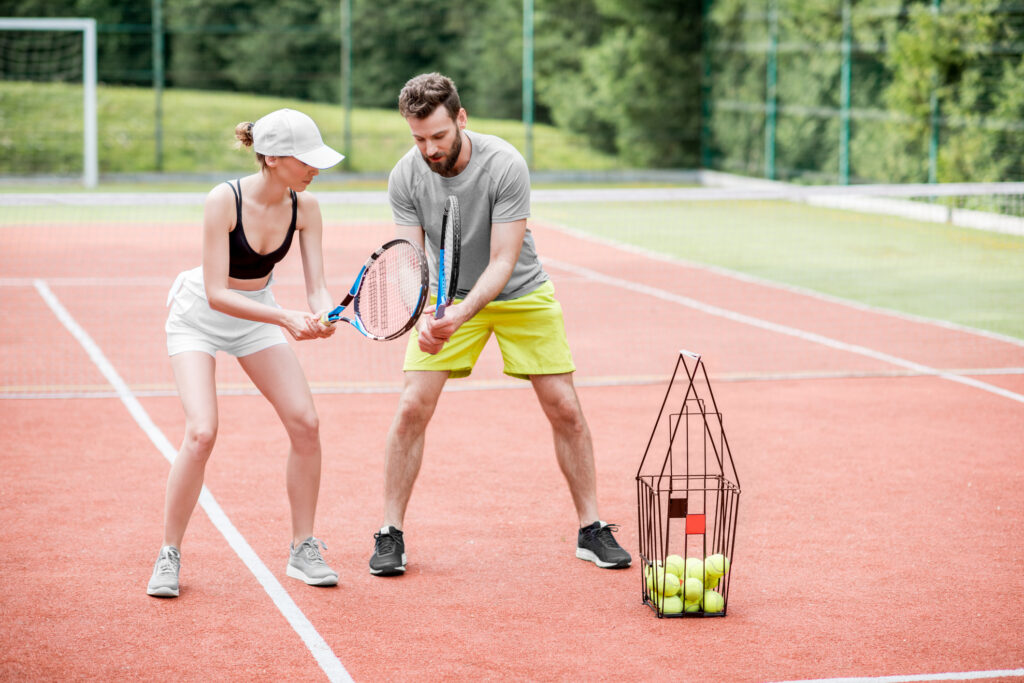
Sometimes when tennis coaches talk too long they sound like Charlie Brown’s teacher. Of course I’m probably guilty of this at times also but to drive home my point, I’ll find myself using these tidbits.
- You are in battle and your forehand is the sword and your backhand is the shield. Like some of the other phrases, I didn’t invent this one. Generally at the higher levels players tend to try and attack with the forehand and defend with the backhand with the intention of defending well enough to get a chance to attack with the forehand.
- Your left arm is looking like a lizard’s tongue. This is for a righty with their non-hitting hand on the forehand when they quickly put their left arm out during preparation and just as quickly bring it back in. Not what one wants to do. Of course, I need to have the type of relationship with the student where I can be so direct and they think it’s funny/relatable.
- Everyone is a duck. I wrote an article on this previously. This basically means don’t get emotionally attached to your opponents attitude, demeanor and game. Everyone you play brings different things to the table and you should keep it about you and what you need to do to play this duck.
- Pretend you are a revolving door. I like this analogy in relation to hip rotation through ground strokes. If the middle of a revolving door was locked it wouldn’t turn while the ends of the door are stationary and the door moves fine. While the legs, hips and core help generate more power, I like using this example for the hips and especially the core.
- What’s the difference between a tennis player and someone who plays tennis? Your answer is the split step! Pretty self-explanatory and something I think is important for any child looking to impress their school coach.
- Bend-and-extend. This expression definitely predates me but this is where so much of the power comes from. I remember coaches tell me to bend my knees. They never told me to extend them. Did they not know? Did I do it? Who knows but so much of the power on shots comes from bending and extending the knees and/or elbows.
- Think of your legs as a cell phone battery on your groundstrokes. See number 6. The bent knees at the lowest point is a fully-charged cell phone battery not used yet but ready. Extended legs is when the battery is at 0%. The important part is what happens in between.
- Hit it to the moon. I like using this when somebody is pushed deep behind the baseline, they need to hit a high-defensive shot and it will be impossible for them to get enough power to hit it over the opponent’s baseline.
- The slice brings you closer to a 50 percent chance of winning the point so don’t use it when you are controlling the point and try to use it when you fall behind. This isn’t an absolute truth but I think it does hold a majority of the time.
- You’re playing a pusher. We know it’s going to be frustrating. Go behind the club before your match and throw your racquets in advance. This tongue-and-cheek suggestion is intended to prepare my student for the frustrating points that a pusher often wins because once the match starts you’ve got to keep your cool and forge ahead. Don’t get caught being surprised! Don’t fall victim to the pressure of the rally. At the end of the day, 95% of matches outside the pro level are won by the person who makes less errors. Yes, part of the goal is to force your opponent into errors but if you are losing the rally rather than “check out” and go for a low percentage shot because you feel like you are about to lose the point, get the ball back in play and make them execute the last 20% of the point themselves.
- I didn’t love that. Actually I am being nice. I hated it.
- Let’s see the helicopter arms. This refers to the arms being linked and in sync on the forehand. This refers to the arms tearing through the air to get power like propellers of a helicopter.
- Walk through the door to enter the point. Too many times at the lower levels players march horizontally through the court and turn around to either serve or return. When is the last time you’ve seen a professional player do this? Always walk to the baseline while facing your opponent’s side of the court to mentally not rush and get ready for the next point.
- Respect everyone. Fear no one. I credit my college coach Dick Gould for this one. I still remember him telling us that San Jose State recently lost a 6-1 match to UCLA and since we (Stanford) lost to UCLA two years earlier we better respect San Jose State that afternoon. Fear no one is self-explanatory. No matter who you are playing, you deserve to be on that court as much as they are!
- Hover! “No Mans Land” isn’t always bad. Sometimes one might hit a shot from inside the court which is not good enough to approach the net on but is offensive enough that it’s not a good idea to retreat to the baseline. This is when you wait in No Mans Land to take advantage of another short ball or come in and pick off a floating volley.
- Would you throw a ball farther if you were in the shallow end of a pool or the deep end where you have to tread water? The answer is you would throw further from the shallow end but you would have to work harder to throw it far from the shallow end. The reason this is significant is that it exhibits how the ground gives you more power when you use it correctly than swinging your arms independent of the body ever can.
- Forward, back, hip, lift! If you guessed these are quick cues for weight transfer on the serve…you are correct. This is short for rock forward, rock back, rock forward leading with your hip and using your hip to lift up your body to extend up to the serve.
- Play “plus one” tennis. Simply put, hit every shot like you intend on hitting another shot, rather than taking a risk going for an outright winner unnecessarily. It’s like going for the two-putt in golf. This strategy is not for pure shot makers but is good if you do not miss much, you are trying to physically wear down your opponent and feel confident that you can win as long as you don’t beat yourself.
- Ole! Meant to mimic a bull-fighter when a player pulls their head or body up from a short hop too quickly like a matador does with his cape.
- Get your work boots on this is a blue collar shot. Short hops, half-volleys, fast shots while you are at the net. Shots that you don’t want to hear an “ole” because you’ve got to be tough, physical and stay in the shot. Get low, get your head down and be tough! These shots are the ones that would most likely elicit an “ole!”
- Take away time. Of course you can’t really take away time but when your opponent is off the court it is more advantageous to hit your next shot earlier either on the rise or inside the court so you take away their chance (or time) to get back into the middle of the court. When your opponent is in the middle of the court it’s not as necessary to take their time away because they are presumably ready for the next shot. This also applies to someone who has a very long backswing. If you can hit with pace it will take away time for them to execute this big backswing and often force errors.