
Functional Movement Screening
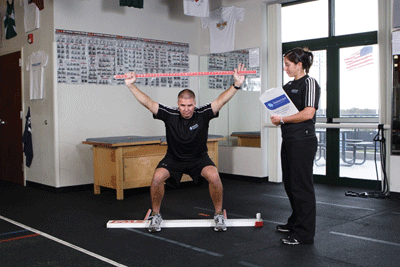
Would you like to stop feeling as if your energy is being sapped as you are playing tennis, and even eliminate the aches and pains you feel afterwards? A functional movement screening (FMS) may be the solution.
The purpose of the functional movement screening is the assessment of an athlete’s general mobility and stability with special attention to asymmetries. Measures are taken through observation of a series of athletic positions common to athletic activity, which will allow the screener to locate the problem and prescribe corrective exercises to re-educate the body into proper functional symmetry.
An FMS can indicate whether there are energy leaks, or a reduction in the body’s ability to perform at maximum levels. These leaks translate into sub-optimal performance and a much higher chance of injury. Ideally, our muscles, ligaments, tendons and nerves work in perfect harmony as they receive messages from the brain. Those communications cause us to move with precision, proper speed and power.
A complete FMS includes seven tests for qualitatively assessing functional movement:
►The Deep Squat challenges total body mechanics when performed properly and assesses bilateral, symmetrical and functional mobility of the hips, knees and ankles.
►The Hurdle Step challenges the body’s proper stride mechanics during a stepping motion and assesses bilateral functional mobility and stability of the hips, knees and ankles.
►The In-Line Lunge challenges the body’s trunk and extremities to resist rotation and maintain proper alignment and assesses torso, shoulder, hip and ankle mobility and stability, quadriceps flexibility and knee stability.
►The Shoulder Mobility Screen assesses a bilateral shoulder range of motion, combining internal rotation with adduction and external rotation with abduction.
►The Active Straight-Leg Raise Test assesses active hamstring and gastroc-soleus flexibility, while maintaining a stable pelvis and active extension of the opposite leg.
►The Trunk Stability Push-Up assesses trunk stability in the sagittal plane, while a symmetrical upper-extremity motion is performed.
►The Rotary Stability Test assesses multi-plane trunk stability during a combined upper and lower extremity motion.
Most importantly, the FMS can identify overcompensations and prevent micro-traumatic injuries. It can help prevent future injuries and compensations by addressing potentially damaging functional patterns. Undergoing an FMS and following a prescribed exercise prehab program over a given period of time increases the likelihood of a significant improvement in performance.
Drs. Holly and Steve Jonas perform Functional Movement Screenings at Jonas Chiropractic, (516) 921-1925, located at 2A Jackson Avenue in Syosset, N.Y.