
Hitting With Rosewall
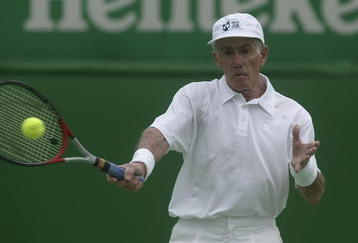
As tennis fans enjoy the 2010 U.S. Open, I cannot help but think about the man who won the event in 1956, Ken Rosewall, and the time I hit with him.
I don’t know why I started by volleying when I faced the great Rosewall across the net.
Maybe it was because I’d been videotaping a match between Ken and three campers at the Tennis Legends event at the John Newcombe Tennis Ranch, and I had the camera and tripod positioned by the net post. Or maybe I started at the net because I learned to volley from another former Australian Davis Cup team member, Warren Woodcock. One thing those mid-century generations of Aussie champs could do was volley, and by extension, teach volleying. It’s not that surprising if you recall that three of the four Slams were on grass for most of the period they dominated. It could also have been that these Aussies owned the volley because most of them used a continental grip, which is the best volleying grip.
Anyway, when one of the campers had to take a bathroom break and the other two decided to get a drink, (of water, not Foster’s), I saw my chance and I took it. I picked up one of the racquets the guys had put down, and before Ken had a chance to walk off the court, tapped a ball softly toward the baseline where he was standing and said, “C’mon, Ken.”
He was kind enough to hit it back to me, gently. I’m sure when the organizers of the event signed up Ken and the other former champs, part of the deal wasn’t that they had to rally with the staff. But to say Ken is polite and gracious is an understatement. So he indulged me.
When I was learning to play as a kid, Ken was my hero. Part of what I liked about him was how cool his name sounded. Someone once wrote a poem about the baseball player Curt Flood’s name. The writer liked it because it implied such opposite qualities. I felt the same way about the combination of rose and wall. And it didn’t hurt that we have the same birthday.
But even more important was the way he played. His strokes were crisp and conventional and he covered the court like it was the size of a postage stamp. I remember one of my teenage tennis pals saying he must use a lot of hair tonic because it seemed like his hair was never ruffled. I also identified with him because of his slight stature. Of course, being small, the other Aussies gave him the nickname “Muscles,” because he had so few of them. Watching Ken play Fred Stolle or John Newcombe was like watching a point guard take on a forward or a center.
John Newcombe, another Aussie tennis great, told a story that week about the first time he practiced with Ken. Newk said he was 17, so Ken must have been 27. Newk said that by 17, he was hitting a formidable serve … hitting the cover off the ball, as he put it. But practicing with Ken was a humbling experience, because as hard as he was banging the serve, Ken was able to return it nearly as hard and place the returns for winners. Andre Aggasi had a great service return, but I’d stack Ken’s up against it.
Another reason I loved Ken’s game was that he used conventional strokes. The problem I had with Ken’s near contemporary, Rod Laver, besides the fact that he was a lefty, was that Laver took huge swings and used tons of wrist. It looked like a hard way to play unless you had Laver’s talent. As a kid, I needed to believe that if you learned the conventional strokes right, even an average athlete like me could get some mileage out of them.
If I’d seen John McEnroe’s volley when I was learning the game, I’d have been really confused. I might have just concluded that McEnroe’s volleys are proof that lefties are all weird. In any event, as great as Laver was, and as much as I liked watching him play, there wasn’t much for me to copy there.
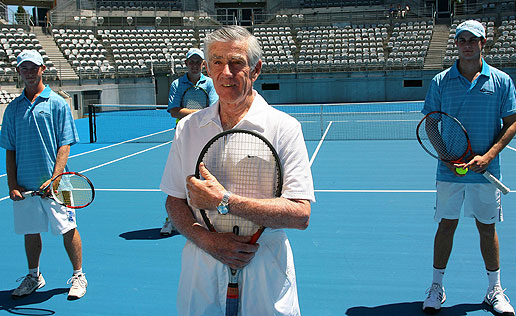 I also admired Rosewall’s counter-punching style. He could turn an opponent’s pace against them better than anyone of his era. And then there was his slice backhand. He could also come over the ball, but nobody has ever hit such an aggressive slice backhand. Ken talked about how he hit it that week at the Ranch. He said he hit through the ball more than nearly anyone has been able to. As a result, he produced a heavier ball that didn’t tend to sit up like most slice backhands.
After Ken Rosewall hit a few soft balls at me, he picked up the pace a bit. Only to what were for him probably half-speed drives, but I was volleying them with control back at him. Soon he was picking up the pace every few shots as he saw I could handle it. I think we hit for about 10 min., before the guys came back. When they returned, I thanked him and went back to taping the match.
Part of the thrill I got from hitting with Rosewall was subtle. As time passes, there are fewer and fewer of us who had a chance to take lessons from or just watch, the Australian Davis Cup team members who dominated the game in the pre-Open era. When I was hitting with Rosewall, I was using a grip that is dying out and hitting mostly a shot whose importance has shrunk from its glory days. So I was sharing in a small way that culture, which includes Australian camaraderie and a taste for Foster’s beer that has faded along with wood frames and white balls.
The other thrill was also fleeting. I was hitting with Ken Rosewall and for a moment, he must have realized I had some game. Not a ton, but still …
Thanks, Muscles.