
How Tennis Teaching Has Evolved, And How To Coach Better
November 25, 2025 | By Steve Kaplan
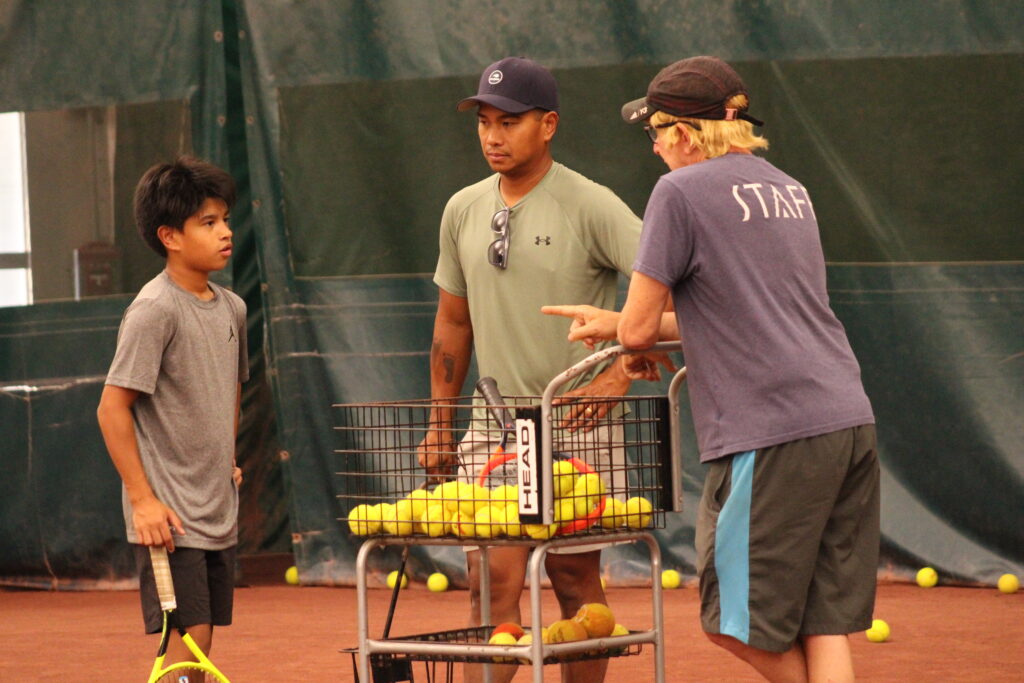
I have written a lot about the importance of coaches being willing to learn, and continuing to evolve in order to provide the best instruction for their students. When I was approached for the Coaches Roundtable feature this month, one of the questions asked to me was what “fundamental beliefs about tennis technique have you questioned or changed over time”?
Here are some:
- First I believe the language that we use in tennis is imprecise and potentially misleading. Do we really “step into the ball” or “towards the ball”? Are we really “late” when we hit, or “mechanically disadvantaged”? Should we cue, “bending our knees” or “hindging our hips”? Words matter.
- This failure of language is perhaps most misguided in the terms “topspin” and “side spin” Almost every topspin shot has a tilted axis of rotation and an element of side spin. So balls can spin in the direction they are propelled or counter to the direction they are propelled. They also all have an element of tilt and spin to the right or to the left. The question is not if the ball has Side Spin. The question is “how much side spin the ball displays?”
- The emphasis on racket speed is somewhat misguided. Work or Power is Force over Time, so our ability to generate power in a hit is the convergence of acceleration and speed at the highest point.
- While the kinetic chain works from the ground up, the kinematic open chain does not. Most tennis movements are open chain kinematic movements. So for example on a serve, flexion of the wrist triggers pronation of the forearm which triggers internal rotation of the shoulder. Many believe this long axis rotation works from proximal to distal; it does not.
- The pros do not hit “way higher over the net”, as many claim. A study of hundreds of thousands of hits reveals that the ATP net clearance average is just 2.1 feet and the WTA average is 2.2 feet. College and high ranked junior net clearance heights are very close to the same.
- We do not need to manipulate our swing path with active effort. Rather, if we relax and sequence the movement of our body relative to our arm we can allow centrifugal acceleration to create a repeatable and optimal path.
- The sweet spot of the racket face is not the optimal spot to contact the ball. It is the spot of the least vibration, but physics tells us that lower on the racket bend nearer to the center of mass of the racket is the “node.” This spot imparts greater energy as well as greater resistance of unwanted rotation.
- “Form creates function and function creates form”. So before we correct a movement it’s vital to understand if the issue is in itself a dysfunction, or a correcting compensation due to a different dysfunction.