
Long Island Tennis Magazine Film Review: Venus and Serena
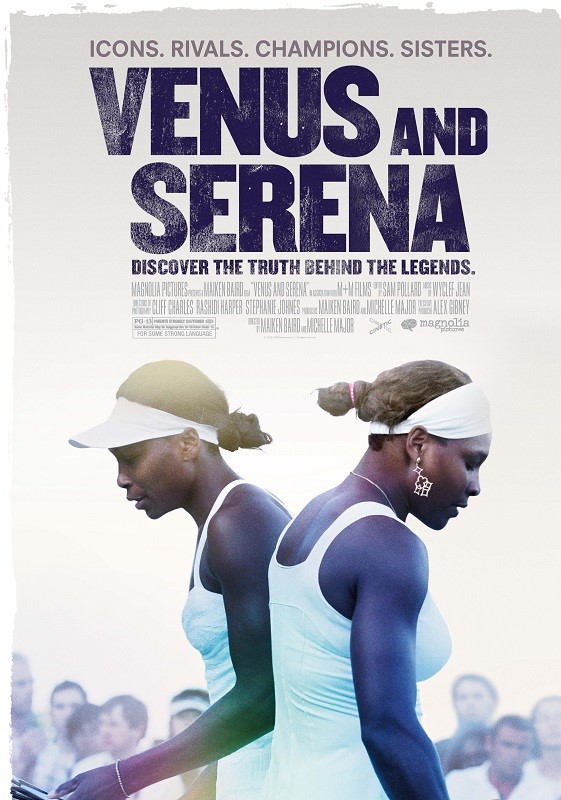
The first thing that strikes the viewer about the documentary Venus and Serena is how its totally front-loaded with sound bites and archival footage. While this isn’t dissimilar to most sports documentaries, the film is somewhat pedestrian in its opening minutes. Emphasizing their training regimen, the combination of multiple elements and disciplines really sheds some light on the championship spirit forged in the sisters. While the documentary highlights both sisters, Serena is the star, as she’s genuinely more fascinating than her older sister and has a ton of personality, where Venus has next to none.
Training is an important aspect of the Williams Sisters’ story. Part of that training includes ballet practice, lifting weights (though Serena admits she never works her arms in the gym) and a stripper pole. That’s right. Serena uses a stripper pole to work out when not on the court. Serena’s struggle through injuries is aided by her exploration of alternative workout methods. It was during this period of injury and recovery (2011) that filmmakers Maiken Baird and Michelle Major followed the sisters. While learning about Venus and Serena’s individual injuries and how they went about recovering is certainly neat, the most fascinating aspects of the documentary highlights the poor economic and social aspect of the girls’ Compton upbringing. That upbringing, with their dad, Richard Williams steering the ship, is perhaps the key to the Sisters’ domination of the sport.
Richard, who plays the part of over-protective father and consummate perfectionist quite well, is a character deserving of his own documentary. Born and raised in the racially-charged south, Richard comes across as both obsessed with his daughters’ careers/training as well as protecting them from hangers-on. In one particular sequence, Richard interrupts a journalist conducting a television interview with an evasive Venus, demanding that the reporter “move on” with his questioning and that Venus’ weak answers are gospel. Supporting one’s children is one thing, but there is a point where Richard comes across as borderline nuts in his obsession. When he’s revealed to be something of a ladies’ man, Richard, as a character, becomes slightly more endearing, if only because there’s a crack in the armor revealing a silly romantic.
Overall, the film seems like it was produced a few years too late. While the Williams Sisters are clearly still a force to be reckoned with, they’re not at the level they once were. The film isn’t particularly remarkable in that there isn’t much time devoted to the controversies surrounding the sisters over the years, or their personal lives. Serena’s chain-dating and ideal man are discussed, but not in great detail. The film is like a tease of great, interesting things to come, but those things never show up. The one area where the film shines is when the girls’ younger years is discussed. Enter Rick Macci.
Macci’s presence in the film is genuinely fascinating if only because it seems that Richard Williams made promises to him that were never fulfilled. Williams, who gushes over Macci’s instruction of his daughters in a type-written letter, would later go on to divorce his daughters from Macci, with the two sisters even going so far as to practically ignore the question raised by the filmmakers regarding Macci’s instruction. Like everything else in the film, though, there’s simply not enough. One of the more controversial elements of the Williams story is referenced once and then ignored to re-focus on their current training and injuries.
Other controversial elements, such as Richard’s womanizing, the light sibling rivalry and the extended family of Williams children just aren’t examined enough. The film likes to close the book on chapters barely touched upon and that’s a problem. When shedding light on a subject, that subject needs to not be afraid of their depiction. It’s easy to speculate why this was the case, both Baird and Major are inexperienced directors (Venus and Serena being their directorial debut), however; watching Richard Williams interrupt news reporters and micromanage every aspect of his daughters’ lives is an issue too obvious to ignore.
Interviews with John McEnroe, Billie Jean King and President Bill Clinton (among others) help highlight the Williams Sisters’ story. There are some fun, intimate moments with the sisters during their training to get back to competition-level, which is perhaps the strongest aspect of the documentary. In that sense, the film succeeds. The Williams Sisters are a dynamic presence in the sports world, so the subject matter is clearly there.