Madison’s Key
How the American broke through to win her first career Grand Slam title
Even for the most talented people in the world, no matter the field or industry, self-doubt is something that affects everyone. That is especially the case in a sport like tennis, when oftentimes, besides the opponent on the other side of the net, you are left with just your own thoughts and emotions to deal with.
For Madison Keys, turning to therapy helped her cope with those emotions and the conversations she was having with her inner-self. And the American was not interested in doing it necessarily to produce better results on the court, but to just guide her through a strange point in her life.
“I finally got to the point where I was personally low enough that I was like, I don’t really care if this helps me perform, I just want to feel better,” she confessed.
And while her reason for beginning therapy wasn’t exactly tennis-related, she has seen it manifest itself in a positive way on the court.
“For whatever, it was kind of just like this light bulb moment where I started really buying into [the idea that] I can be nervous and I can still play good tennis,” she said. “Those things can live together. So I stopped fighting, trying to push away the feelings and pretending that they’re not there, and just accepting them and really telling myself that they’re fine and they’re totally normal to be there, and I can still play tennis.”
That newfound mindset was a powerful one, as Keys was able to separate her self-worth from the wins and losses she produced inside the white lines of the court. She was overcoming a feeling she had since coming onto the tour and reaching the semifinals at the Australian Open as a teenager. From that point on, she had expectations placed in front of her both internally and externally.
“From a pretty young age, I felt like if I never won a Grand Slam, then I wouldn’t have lived up to what people thought I should have been. That was a pretty heavy burden to carry around,” she explained. “I finally got to the point where I was proud of myself and proud of my career, with our without a Grand Slam. I finally got to the point where I was okay if it didn’t happen. I didn’t need it to feel like I had a good career or that I deserved to be talked about as a great tennis player.”
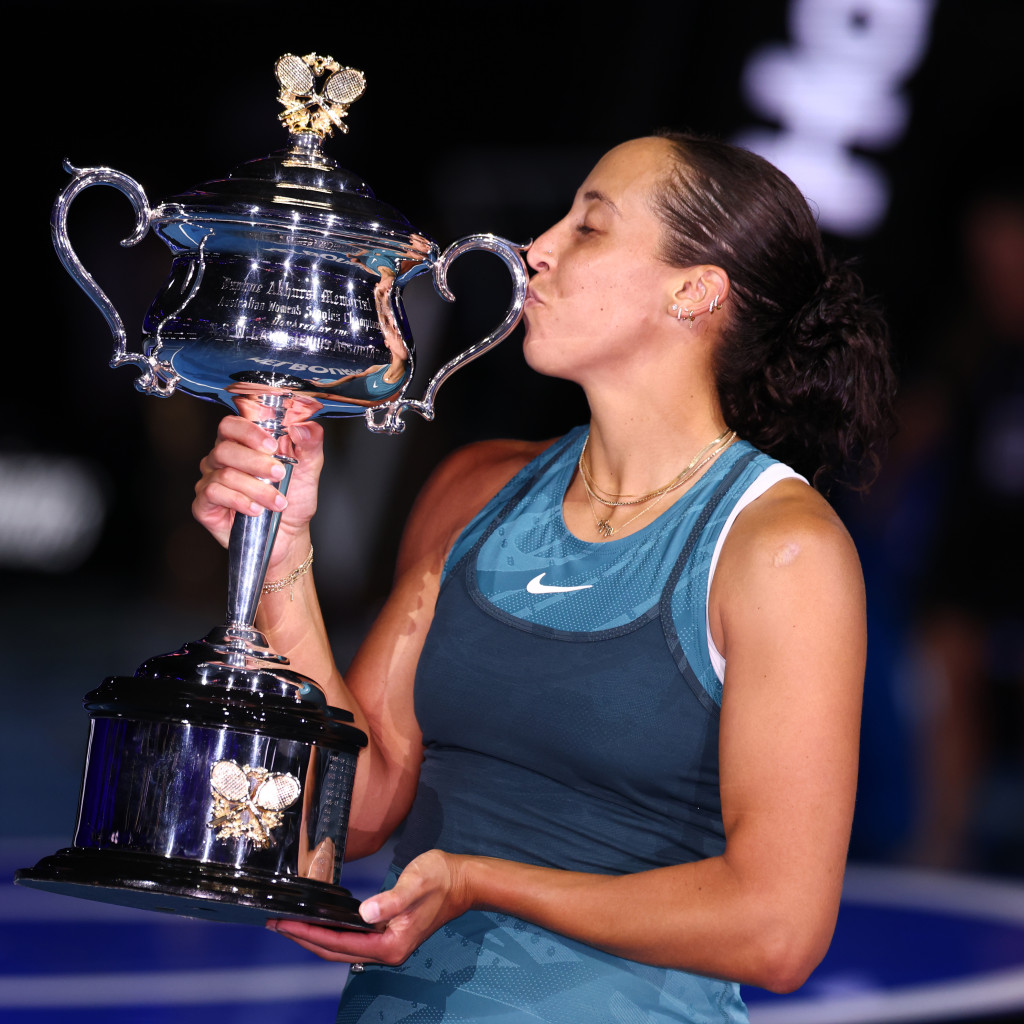
And the irony of all of it is, by playing freer, and without the burden of undue pressure on herself, Keys was able to achieve that Grand Slam dream. She earned the first major of her career at this year’s Australian Open by upending the two-time defending champion and world number one Aryna Sabalenka 6-3, 2-6, 7-5 in the final.
The major title came nearly eight years after she reached her first major final, a trip to the 2017 U.S. Open championship, where she fell to her compatriot Sloane Stephens.
“I’ve wanted this for so long. I made my very first Grand Slam semifinal here in Melbourne, so to now have won my first Grand Slam in the same place means the absolute world to me,” said Keys in her on-court interview during the trophy celebration. “I have been in one other Grand Slam final and it did not go my way, and I didn’t know if I was ever going to be able to get back to this position to try to win a trophy again and my team believed in me every step of the way…They believed in me when I didn’t believe in myself.”
That belief went a long way in the final itself, as Keys found herself in a tight contest with Sabalenka late in the deciding third set. Serving at 5-5, 30-30, Keys had to dial up one of her best shots of the entire tournament, returning Sabalenka’s heavy forehand with an even heavier one of her own for a winner.
It was the type of power that has been associated with Keys’ game, and was on full display in one of the biggest moments of not only the match, but her career.
“That’s kind of just how I want to play tennis. I’m not going to sit here and say that forehand at 30-30 is going to go in all the time. It might not. Sometimes it might go out, sometimes I might bury it in the bottom of the net. But sometimes it will go in,” she reflected. “If I can continue to try and do that consistently, then not only will good things happen but I’ll always walk away and be proud of myself, and that’s all I want at this point, to be proud of what I leave out there. That’s what I’m getting better at, being able to consistently be proud of not only my level, but my ability to problem-solve and be very aware of what’s going on.”
With her maiden title, Keys becomes the fourth-oldest first-time major champion, behind only Flavia Pennetta (2015 U.S. Open), Ann Jones (1969 Wimbledon) and Francesca Schiavone (2010 French Open), winning her first title just weeks shy of her 30th birthday.
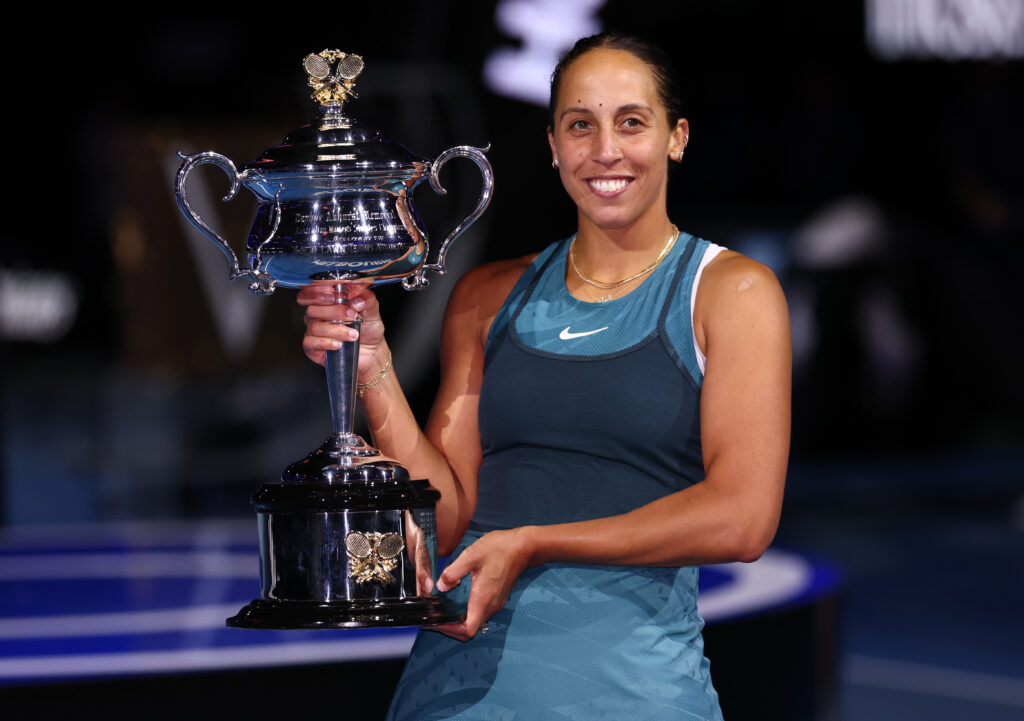
Keys’ journey is proof that progress is not always linear, and just because you did not immediately live up to the expectations people have for you it does not mean you are a failure. The next step is how will Keys build off of this. She is currently ranked seventh in the world, equaling her career high from 2016. She is well-aware of what she accomplished in January, and understands the result is not something that happens in a vacuum, and would not have been possible without all the other results, whether they were wins or losses, in the past.
“I’m so proud of myself, and I feel like the way that I won this tournament means so much more. The place that I am in my life, I’m able to actually really appreciate it,” she said. “Had I won it earlier, where I was in my life, I don’t know if it would have meant the same and I don’t know if I would have even been able to have done it.”