QuickStart … An Accurate Name
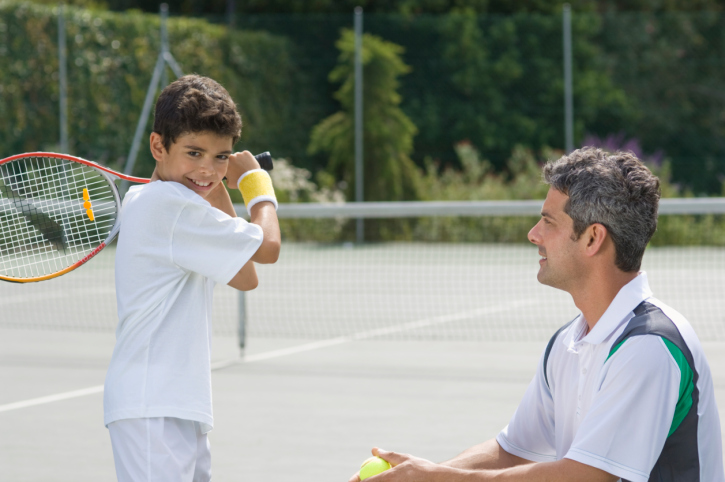
I love QuickStart and if you have a young child interested in tennis, then you should love it too! It’s taken a while for me to get to this point, but here I am professing my love for something that, just a few years ago, I was very skeptical of. What is QuickStart tennis? It’s the tennis balls with the funny colors orange/yellow, red/yellow and green/yellow. They’re low compression balls, so they feel flat and dead, and don’t bounce as high. QuickStart uses modified courts with short nets. It’s awkward, weird and completely strange because it is different … but it’s effective! QuicksStart can get children, young or old, playing tennis. They have fun and improve their game.
I first heard about QuickStart at least six years ago when I attended a demonstration and training session. It seemed like a novelty back then. I was resistant to its potential for the wrong reason. My reservation was that it was new. Most sports are not open-minded enough to endorse new and emerging paradigm shifts and tennis is not exempt from this idea. “Tennis champions have been trained for decades using regular tennis balls, so why fix it if it ain’t broke,” was my thinking. I was worried that my students would not have an exit strategy with the new balls. I was concerned that they would get used to hitting a slow, flat ball and never get accustomed to a fast, traditional ball. Their timing would be ruined and they would never be able to excel. Looking back in time gives us 20/20 vision though, and I’m happy now to both use and encourage the use of the QuickStart balls and the QuickStart program.
One of the problems in teaching young children is that it is hard for them to develop the habit of hitting the ball at their waist. No matter how good a feeder the professional is, the traditional tennis ball just bounces too high for someone so young (short). I believe that this is why we see so many professional players with semi-Western and full-Western grips now. It makes sense because the professionals of today grew accustomed to using these grips to compensate for balls bouncing high and having to strike it above waist-level. QuickStart balls solve this issue though. From a very young age, it’s easier for the child to hit the ball at the waist-level because the ball is not bouncing as high. The ball is appropriate for them. Learning happens at a more rapid pace.
Another issue was that the traditional ball is difficult for kids to get a solid strike. The ball feels too heavy. Children compensate for that by swinging wildly and creating a problem of the ball flying far and out. QuickStart balls alleviate this issue because they can be struck easily, due to their low compression, and do not fly out.
The combination of factors leads to one result—rallies. Rallies are what move the needle in terms of improvement. Results cannot be seen without rallies. When a child can rally, the world of tennis opens up to them. Now, they can play points and learn new skills, the pro can use different drills and begin to work on their tennis IQ even sooner.
QuickStart makes the learning process easier on the pro and better for the student. Children get more out of the program and have fun doing it. I sincerely hope that now, with a few years of the program being in use, that parents, pros and facilities alike being to trust it more as I have. Hopefully, this will also lead to a new generation of enthusiasm in tennis and some American champions at the majors down the road.