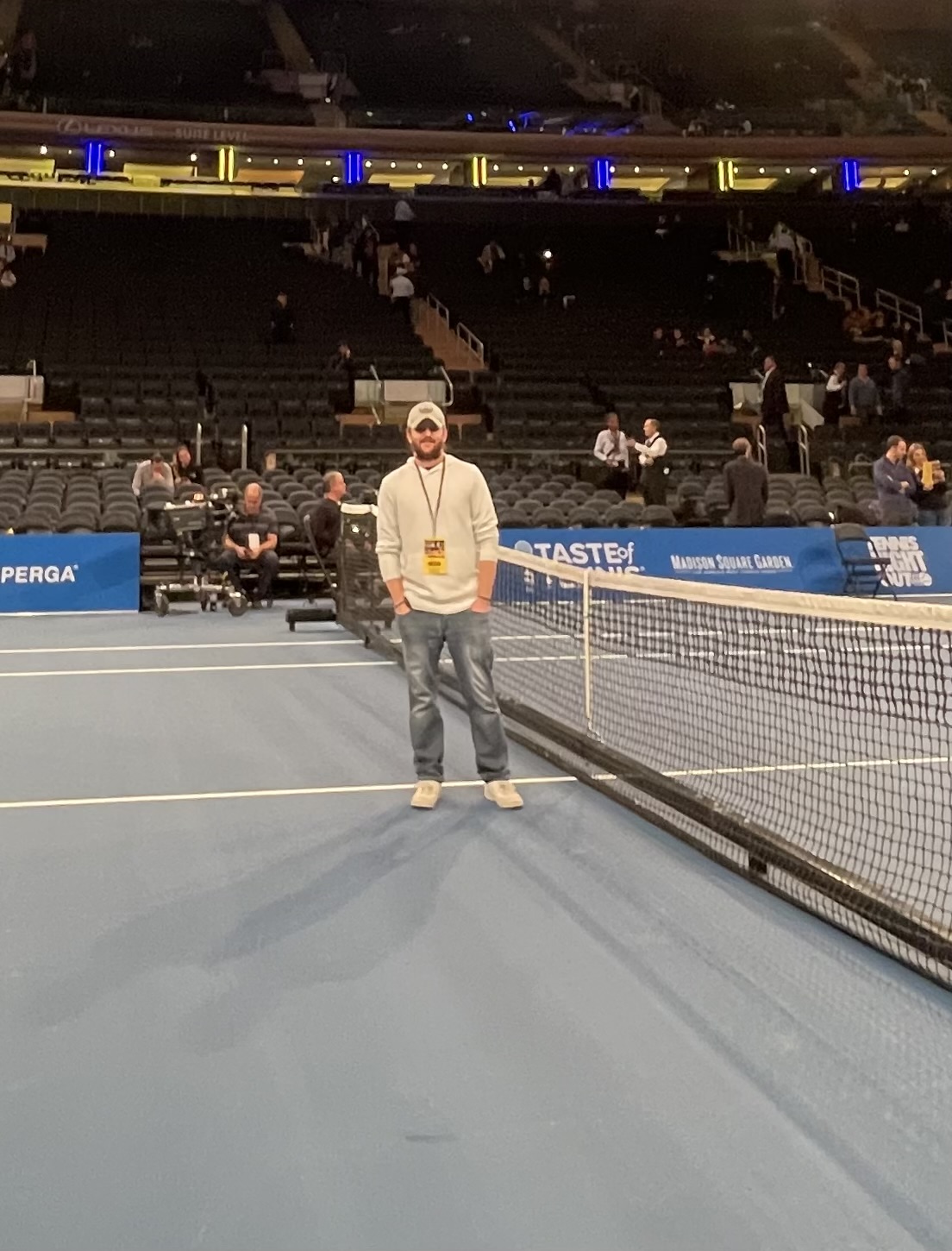
At The Net With Author Robert Lopez – How Tennis Can Connect Us
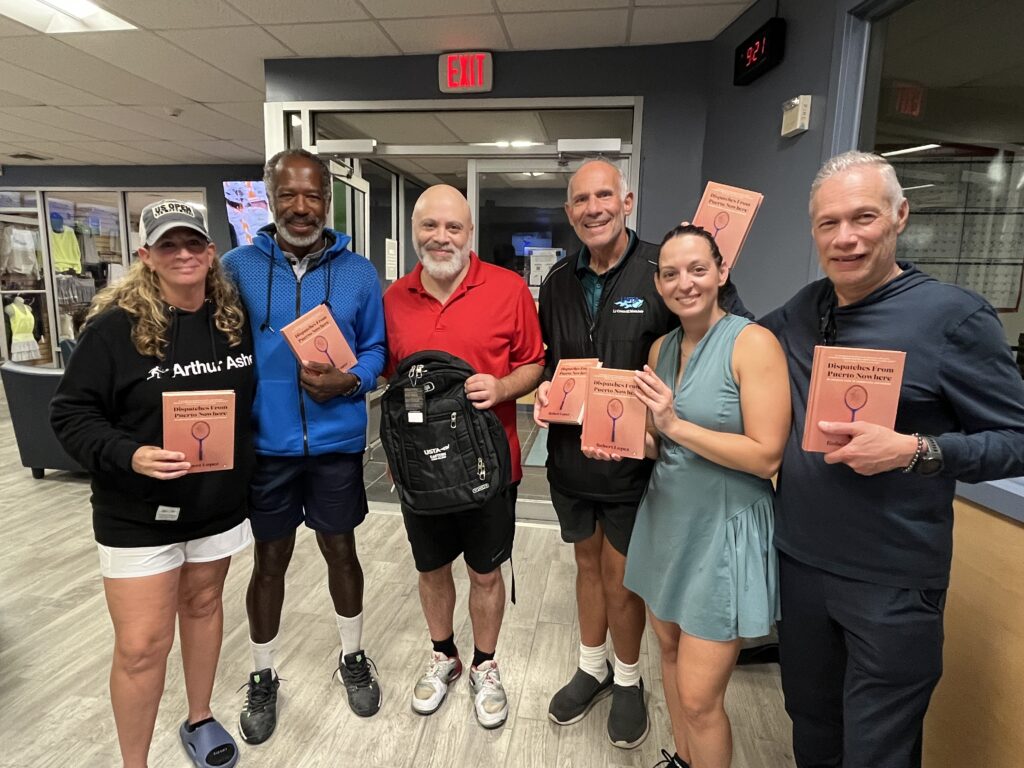
With the country in the midst of celebrating Hispanic Heritage Month, USTA Eastern welcomed author Robert Lopez to Grow Tennis New York’s Courts & Cocktails event at SPORTIME Syosset.
Lopez spoke to the sold-out crowd of participants about his book, Dispatches From Puerto Nowhere: An American Story of Assimilation and Erasure, which tells the story of Lopez’s disconnect from his family’s heritage, and how the sport of tennis has helped him in his journey to reclaim his identity.
He analogizes it by saying:
“I go back and forth with what I’ve lost through erasure and what I’ve gained by assimilation and what it all means,” he writes in the book’s prologue. “The back and forth is like a tennis rally and how different shots behave on the court. Mario’s flat backhand will rush through the air and stay low, whereas the topspin Teddy puts on his forehand will have the ball kangaroo past shoulder level. Wayne’s backhand slice skids off the ground and eats you up if you’re not ready for it.
In Brooklyn, I live in the American melting pot exemplified by the diverse tennis community of which I’m a part. Most everyone has a history or at least a mythology, the stories we tell each other and ourselves, idealized narratives that we can talk about during changeovers and water breaks. Even I play the game, but it’s a hollowed-out mythology when I tell it, and almost entirely a fiction.”
It’s a fascinating dynamic that immigrants have to grapple with when arriving in the United States; toeing the thin line between assimilating while not abandoning their heritage and culture. Even arriving in a place as diverse as New York City, it’s a juggling act that all immigrant populations are forced to engage in.
For Lopez specifically, he explains:
“It seems like recent immigrant populations do a much better job of holding onto their cultures, and I think diversity of culture if what makes life interesting and rich,” he said. “But both sides of my family, Puerto Rican on my father, Italian on my mother, threw themselves wholly into assimilating when they arrived in the early part of the 20th century. Working class people were all about assimilation for a long time and as a result, the language, customs and mores, music and history, above all, were lost. It’s the loss of history that feels particularly unfortunate.”
As Lopez embarked on the journey to bridge the past and present of his family’s legacy, tennis has become an integral part of that path as well as his life. Growing up, he played many sports across the vast parks that inhabit NYC. But tennis wasn’t one of those, and it was only later in life that he engaged with the sport.
While he had always watched tennis on television, and attended the U.S. Open a couple of times, it wasn’t until he was 40 that he began playing.
“The truth is, I picked it up in the wake of a failed relationship, and figured that was the best way to turn the focus elsewhere,” he says. “The journey has been extraordinary. I started hitting with one friend and before long I had a dozen or so partners. The community in Fort Greene was glorious back then and very welcoming.”
Lopez has seen his game get better and better, and he now finds himself fully assimilated into the tennis world, providing a scouting report of sorts on his own game.
“It’s truly something to feel yourself improving in various aspects of the game if you play often enough,” Lopez explained. “I showed up to the sport with a big two-handed backhand and take a lot of pride in how far the forehand has progressed. I do regret not picking up the game earlier to an extent, but I also think everything in its time is a valuable way to think about one’s own life.”
Tennis has not just been a way for Lopez to meet new people and develop friendships, it has also been a source of relief and a therapeutic outlet for him. In his book, he recounts a time when he was playing at Fort Greene Park with his friend Mario Aguilar, when he received a phone call from his sister alerting him that their mother was being rushed to the hospital.
He tried to do anything to keep his mind from sorting through all the negative thoughts that naturally arise in a time like that, and while he doesn’t exactly remember what he thought about, he recalls how often tennis has been his meditation and provided solace.
“For most of the past ten years, tennis has been the ultimate distraction. It’s soul-saving therapy four or five times a week, as there is nothing like running around and smacking the hell out of a ball. It’s the best way I know to kill time,” he writes. “I was on the train, trying to kill time, my mother was in a hospital, maybe having a stroke or some other brain-related catastrophe. I didn’t want to think about how this might change her life, change everything. I certainly didn’t want to think the worst, so I tried not to think about anything, which I’ve never been good at. I tried meditation once or twice and the whole time kept thinking about ways to handle Kenny’s left-handed serve spinning out wide in the ad court or how next time I’ll come to the net more often against Mario to shorten the rallies and I’ll hit two first serves because you have to take chances when you play someone like him.”
These are the types of thoughts and internal discussions tennis players have with themselves as they navigate the day-to-day existence, and Lopez is no different. Tennis has become an integral component of what makes Lopez who he is, and he embraces what the sport represents, and the impact it can have on communities.
“The USTA has done a great job with outreach into communities where tennis isn’t a big part of people’s lives, and local groups here in Brooklyn have done likewise,” he said. “And we’re seeing the results on the court. The diversity in New York City is great. Tennis has this country club image, of course, but that isn’t the case here on our public courts. And even on the pro tour, we’re seeing more and more diversity, and it makes the sport better as well as the culture at large. Of course, there’s more work to be done, but it’s a good start.”