

Sports Vision and Eye Dominance
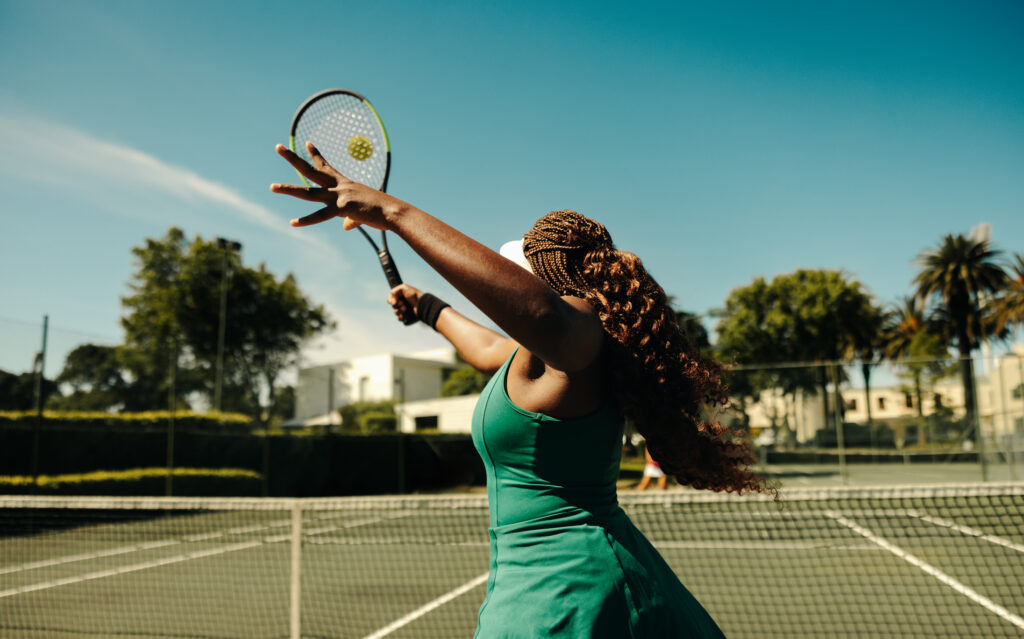
An excerpt from Chris Lewit’s new book, Winning Pretty, which will be available in paperback in 2025
There is now a widespread belief in the tennis coaching world that eye dominance, where one eye is assumed to be preferred over the other for sighting, plays an important role in tennis biomechanics. But is it true and/or helpful?
The theory of ocular dominance states eye dominance should be tested and incorporated into tennis technical development decisions. But there is significant controversy about this subject. Not all coaches agree about the importance of eye dominance and many sport scientists and eye experts question the validity of the connection between eye dominance and technique.
Two highly successful coaches, Jofre Porta and Patrick Mouratoglou, plus professional trainer Paul Dorochenko, are examples of experts in the tennis world who believe in the dominant eye theory. But the question is whether it is real or myth.
The below excerpt focuses on Mouratoglou’s philosophy on this subject. To read more about the contrasting theories, check out “Winning Pretty” on TennisPlayer.net, and be on the lookout for the paperback version to be release in 2025.
Patrick Mouratoglou advises adjusting stances and head position to maximize vision with the dominant eye. Mouratoglou is one of the most famous professional coaches in the world. He believes eye dominance can affect many areas of a player’s technique including their stance, trunk rotation, head position, and contact point.
According to Mouratoglou, by watching top players and the way they set up their stances, shoulder turn, head position, and their contact points, he can often determine their eye dominance just by observing. He believes coaches should actively adjust player technique based on their dominant eye.
Mouratoglou produced a video entitled, “Your Dominant Eye and Your Technique” that went viral in 2023. Because Mouratoglou has promoted the dominant eye theory so publicly, it has become one of the most interesting and important topics in modern tennis technique. But, unfortunately, more and more people are talking about the dominant eye now with less and less scientific underpinning.
Mouratoglou makes many claims regarding the dominant eye and tennis technique. According to Mouratoglou, the dominant eye plays a tremendous role in technique, not just in tennis but in all sports. He says that the dominant eye relays information more accurately than the non-dominant one, with profound technical implications.
Says Mouratoglou:“The neurons respond preferentially to information from one eye versus the other. This means the neurons in your arms, legs, and hands respond preferentially to the information received from your dominant eye, and head position can affect how the dominant eye processes information.”
Eye experts disagree about the veracity of this statement: Don Tieg agrees, while Daniel Laby does not. For Mouratoglou, it is essential for tennis players to position the body so as not to block the dominant eye and to leverage the accuracy of the dominant eye for ball tracking because the non-dominant eye sees the ball less accurately with a small displacement, causing the body to be in the wrong position to receive the ball.
Tieg agrees with this assertion while Laby says it’s important not to block either eye, while focusing on binocular vision. According to Mouratoglou, blocking the dominant eye in tennis is why some players feel less comfortable hitting on one side of their body, either the forehand or backhand side.
Mouratoglou argues that champion tennis technique is always influenced by the dominant eye. “These champions tend to have one side with a bigger shoulder rotation, a more lateral contact point, and a strong transfer. Contrarily, the opposite side has less shoulder rotation, a contact point more in front, and less transfer through the ball. This weaker side uses more ‘wrist action’ to compensate for these differences,” states Mouratoglou.
Alleged Advantages of Cross-Dominance
Patrick Mouratoglou also states that cross-dominance, when the dominant eye is opposite the dominant hand, affords a special advantage in tennis. According to Mouratoglou, players like Roger Federer and Rafael Nadal are famous cross-dominant professional players who have incredible forehands, partly due to their cross-dominance.
Dr. Teig is one expert who agrees with Mouratoglou that cross-dominance is an advantage in baseball and tennis, while Drs. Laby and Kirschner do not. For example, for right-handed players with left eye dominance, Patrick says these athletes can have a bigger shoulder rotation and yet still have great perception of the incoming ball, which means these players are typically in the best position to receive the ball.
This is the first advantage of cross-dominance. The second advantage of cross-dominance is that the larger shoulder turn in the preparation for cross-dominant individuals means more power on the forehand, presumably from a greater degree of separation between shoulders and hips. The larger trunk rotation gives the player more power on this side, according to Mouratoglou.
The third advantage of cross-dominance is that the contact point for cross-dominant players is more lateral, generally between the legs, according to Mouratoglou. Mouratoglou argues that this later contact point allows for more contact time for the strings on the ball during impact, helping to give more control and power to the shot.
Players like Roger Federer and Rafael Nadal demonstrate these three advantages in their forehands, according to Mouratoglou. Mouratoglou also states that cross-dominant players like Roger Federer are very dangerous running to their forehand side because they can see and track the ball with their dominant eye when running laterally. Don Tieg accepts that this may be true.
Same-Side Dominant Players
Mouratoglou describes common characteristics of same-side dominant players such as Alexander Zverev. He says that for same-side dominant players like Zverev, their best shot is generally the backhand. According to Mouratoglou, same-side dominant players have a shorter shoulder rotation on the forehand to ensure their head fully faces the net and their dominant right eye can track the ball.
At the impact, right eye/right hand dominant players will open their shoulders more to the net with their chest facing the ball more at impact than cross-dominant players do and they will tend to use semi-open to open stances to promote better ball tracking with their right eye.
Mouratoglou argues that same-side dominant right handed players tend to have much better backhands than forehands as compared to cross-dominant individuals because they can watch the ball more accurately with their dominant eye while turning more deeply with the shoulders, meet the ball later in the impact zone, and keep the shoulders semi-turned through the impact.
They can turn very deeply on the backhand and still have a good perception with the dominant right eye. The deep turn provides these players with more power from trunk rotation, states Mouratoglou. According to Mouratoglou, the later contact point and semi-open shoulder position favors a long passage through the ball, bringing both power and accuracy on the backhand side. Same-side dominant players can hold the ball on the strings longer for better power and control, asserts Mouratoglou.
To read more about this subject and many more, be sure to visit WinningPretty.com.

