
Wheelchair Tennis
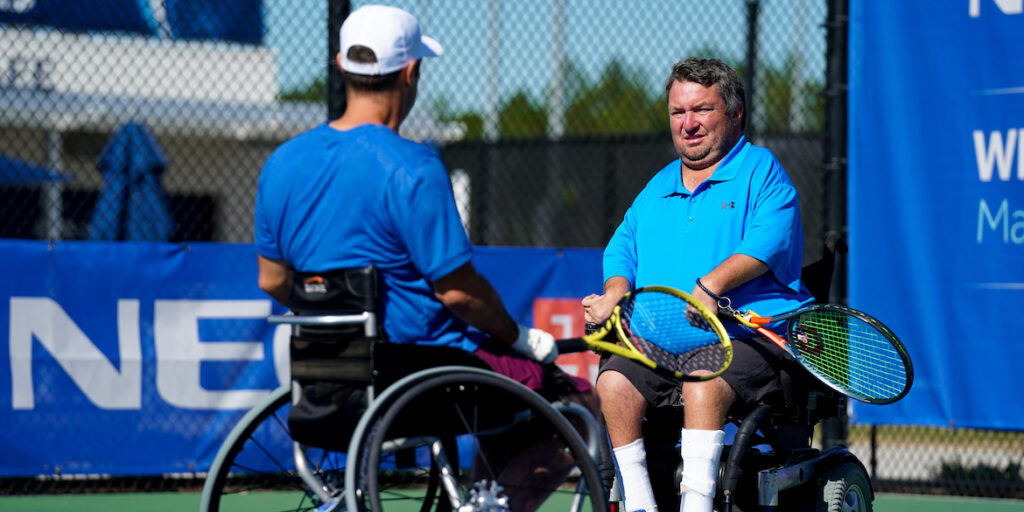
I have been teaching and studying wheelchair tennis over the past few years. It is a challenging, sometimes complicated yet rewarding experience. I usually have four students with different levels of ability and tennis experience, all in the wheelchair category. My preparation for these classes includes in person and online Adaptive and Wheelchair tennis courses but I learned the most on the court working with my amazing students!
Rules
There is only one difference: the two-bounce rule. Wheelchair players are allowed to play a ball after the second bounce however the first ball bounce must be inside the court. The other tennis standard rules and equipment, such as racquet and court size are the same.
Inclusivity
Wheelchair tennis players are allowed to compete in any sanctioned event available to the general public. High school tennis players are authorized and may play against their able-bodied peers in organized team competitions. There have also been many wheelchair players on USTA league teams across the nation.
The Most Common Disabilities in Wheelchair Tennis
The only eligibility requirement to play wheelchair tennis is that one must have a permanent physical impairment from the waist below. Spinal cord injury is one of the most common disabilities, but at the same time, is quite complex. There are four levels of the spine: sacral, lumbar, thoracic, and cervical. The disability manifests itself differently depending on where the injury occurred.
High-level thoracic and cervical injuries often create body temperature regulation problems. This is important to understand when coaching as players will have spray water on themselves or use ice towels to cool down.
The higher the injury in the spinal cord, the less function one will have in the core and sometimes in the arms. Lower spinal cord injuries usually mean more functions available in the upper body. It is important to understand that spinal cord injuries can be complete or incomplete. Although athletes may have the same level of injury, the way in which that injury manifests is always quite different for each person.
In my classes I experienced that firsthand. I asked my students what accommodation(s) I can make for them. After we get to know each other, they are open and are very eager to share their insights and experiences with me.
Wheelchair Categories
According to the International Paralympic Committee, in wheelchair tennis, there are two sport classes:
- The “Open class” is for athletes with a permanent impairment of one or both legs, but with normal arm function.
- The “Quad class” is for athletes with additional restrictions in the playing arm, which limits the ability to handle the racquet or maneuver the wheelchair. However, as it relates to professional wheelchair tennis and tournament play.
- The Open divisions are comprised of Men, Women, and Quad players. The Quad division is coed. If there is any doubt regarding whish division an athlete should classify, there are various classification sessions that occur throughout the year that typically run in tandem with a tournament. However, injuries that greatly affect one’s arms typically qualify for the Quad division. For Quad players, they may need to use an assistive device if they have limited hand function. The most common is taping the racquet to the dominant hand.
Coaching Wheelchair Tennis
To start the program and find players you can reach out to the local rehabilitation hospitals and centers, paralympic sport clubs, Disability Associations, More United Chapter, the local USTA district or section office, USPTA or PTR. There are several nationwide organizations that help individual players obtain sport chair such as the Challenged Athlete Found at the VA.
Preparation for the wheelchair tennis lesson is the same as planning for able bodied class, with exception that the wheelchair class should be at least 1.5 hours long. The coach should know if there is a need for any special accommodations. Air pumps and some basic tools should be accessible. My students come well prepared, but I always have an air pump available. It is important for the coach to know about the different types of the sport chairs. These specialty chairs can be very expensive. I spent two days in the wheelchair during my training and it was a very challenging and painful experience (sore shoulders, blisters, and broken nails). The most important part of coach preparation is to get to know your students! Let them trust you and tell their stories. Their inspiration and knowledge teaches me how to be a better coach and helps me help them to improve.
For me, teaching Adaptive and Wheelchair tennis is a very rewarding experience and I love I am able to give back!