
Your Forehand Isn’t Broken—It’s Outdated: The Mismatch Between Modern Technique and Current Teaching Methods
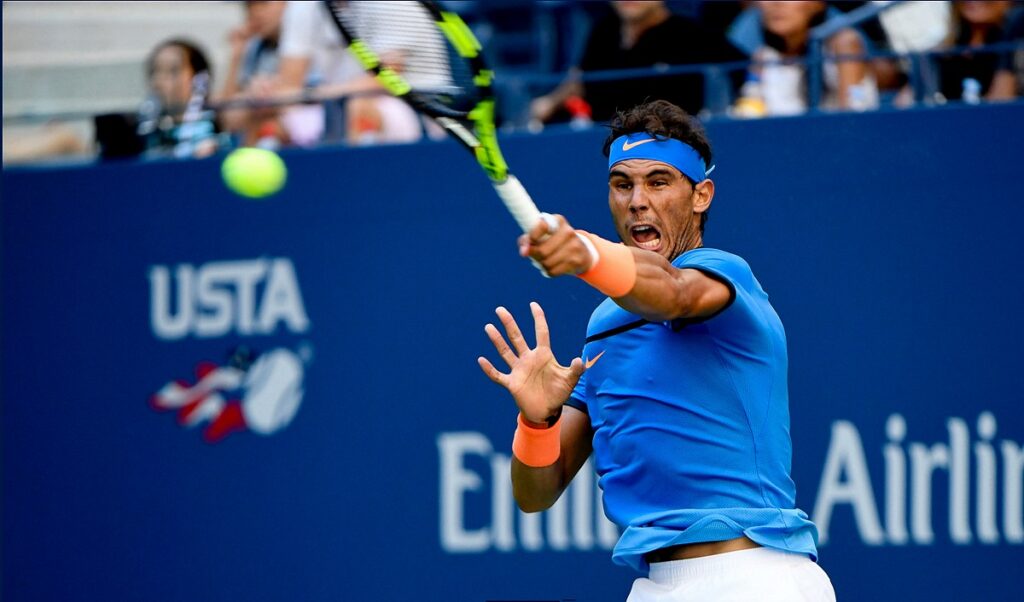
If you or your kid’s forehand lacks power and spin, it’s not a mystery—it’s history. Professional tennis has fundamentally changed how the forehand is struck, yet many players are still using mechanics from a different era.
The modern professional forehand did not appear overnight. Its roots trace back to early frontier players like Björn Borg, Jimmy Arias, and later Sergi Bruguera—players who began breaking away from rigid, linear mechanics and introduced rotation, topspin, and elasticity long before the rest of the sport caught up. What they pioneered has now become the global standard.
The modern forehand at the professional level—particularly on the men’s side of the game—is defined by parabolic swing paths, explosive leg drive, rapid hip and trunk rotation, frequent mid-air ball striking, and lower, reversed, or inverted finishes. Above all else, the defining feature of the contemporary forehand is elasticity.
This elastic quality is not cosmetic. It is structural. It is biomechanical. And it is foundational to how elite players generate effortless power, extreme topspin, and repeatable acceleration under pressure (Elliott et al., 2009).
From Rigid Lines to Elastic Loops
In the 1970s and 1980s, forehands were taught as mostly linear, grounded, and rigid movements. Players were coached to step forward, lock the wrist, transfer weight cleanly, extend through contact, and finish high and firm—often over the shoulder or near the neck.
This model made sense in an era of heavy wooden racquets, grass courts, lower ball bounces and speeds, and flatter trajectories. But the modern game—played with lightweight yet powerful racquets, polyester strings, high-RPM and high-bouncing balls, varied surfaces, and extreme court positioning—demands something entirely different.
Today’s forehand is rotational, elastic, and fluid, built around stretch–shortening cycles in the legs, hips, trunk, shoulder, and forearm. Power is no longer pushed through the ball; it is released through efficient kinetic sequencing and delayed segment rotation (Reid et al., 2013).
The Coaching Lag
What’s remarkable—and frankly alarming—is that despite the complete overhaul of professional technique, many coaches still teach young players forehands rooted in the 1970s and 1980s, often branding them as “solid fundamentals.”
This is not fundamentals. This is historical inertia. I have tried for decades to counter this trend by providing modern instruction both in person, through articles in many tennis periodicals, and on my YouTube channels, Chris Lewit and Tennis Evolution.
Children and adults are routinely taught stiff arms, closed stances, linear swing paths, and rigid finishes during the most sensitive windows of motor learning. Later, coaches attempt to modernize these players by layering elasticity on top of a rigid base—a process that is slow, inefficient, and often unsuccessful.
If your kid is stuck with a coach or club that insists on teaching technique from a bygone era, don’t just walk away—run. You are not avoiding discipline or fundamentals; you are avoiding neurological and neuromotor baggage.
Spain: Tradition Meets Evolution
In Spain, the forehand has always been sacred. Heavy topspin, physical endurance, and point construction have long defined Spanish player development. See my classic book, Secrets of Spanish Tennis, to learn more about the Spanish method. Yet even within Spain, there is a split.
The modern forehand is best understood through elastic, loose fluid mechanics rather than rigid lever mechanics. I discuss these keys in detail in my forthcoming book Winning Pretty, which will be the most comprehensive technique and biomechanics book on the market.
Elastic systems outperform rigid ones for several reasons:
Stretch–shortening cycles
Elastic muscles and tendons store energy during the loading phase and release it explosively during the forward swing, increasing racquet-head speed without added tension (Elliott et al., 2009).
Proximal-to-distal sequencing
Power flows from the ground up only if the system stays loose enough to allow timing delays. Stiffness breaks the kinetic chain (Reid et al., 2013).
Adaptability and spin production
High RPMs emerge from racquet-head speed, angular velocity, and relaxed pronation. Elastic arms create spin; stiff arms suppress it.
In short, looseness is not a lack of control. It is the key source of control and power.
The World-Wide U10 Development Trap
Around the world, it is still common to see children under 10 years old taught stiff, linear forehands, closed stances, and follow-throughs to the ear or neck—often through low-common-denominator Red, Orange, and Green programs. These approaches are typically justified as “teaching the fundamentals.” The problem is that fundamentals are not fixed. They evolve over time.
In tennis, what constitutes fundamental forehand technique has shifted dramatically at the professional level, yet coaching methods, by and large, have not kept pace. Many junior programs continue to teach mechanics that no longer reflect how the game is actually played at the highest level.
What to Look for in Modern Instruction at Your Local Club
A client of mine recently pulled his 10-year-old son out of a green ball program because the training was not accelerated and was actually moving his technique and footwork backward. I see this reported to me frequently by clients across the United States and the world. Well-intentioned programs often slow development by enforcing outdated movement and stroke patterns that no longer reflect the modern game.
As a result, many families turn to private lessons to give their children more modern, efficient instruction aligned with how tennis is actually played today.
What follows are the technical markers parents and players should look for when evaluating whether instruction reflects the modern forehand:
Next time you are watching a kids’ class or taking a lesson, observe whether the technique being taught reflects the modern game or an outdated textbook. You should see:— Open and semi-open stances taught early alongside closed stances
Modern tennis is played under speed, time pressure, and imperfect spacing. Open and semi-open stances allow players to rotate efficiently, recover faster, and hit effectively when they cannot step forward. Teaching these stances early prepares players for real match situations rather than idealized ones. Closed stances still have value, but they should be part of a broader movement toolbox, not the only option.
— Parabolic swing paths with windshield-wiper forearm action after contact
The modern forehand travels on a curved, upward-and-around path rather than straight through the ball. This parabolic shape allows players to swing faster while maintaining margin over the net. The windshield-wiper action in the forearm is a natural result of internal shoulder rotation and forearm pronation, not a forced motion. It is a key contributor to modern topspin and control.— Controlled explosive movement, including players leaving the ground
Many professional players naturally leave the ground during forehands because rotation and force are generated faster than the body can stay anchored. Allowing controlled airtime helps players learn to transfer energy efficiently from the legs through the torso. Suppressing this movement often leads to stiffness and power leaks. The goal is balance and control, not staying glued to the court.
— Strong hip rotation creating racquet lag and a whipping effect
Hip rotation is the engine of the modern forehand. When the hips rotate ahead of the arm, the racquet naturally lags behind, storing elastic energy. This lag is what creates the whipping effect seen in high-level strokes. Without hip-driven rotation, players are forced to muscle the ball with the arm, limiting both power and spin.
— A loose, elastic arm
A relaxed arm is essential for speed, spin, and consistency. Tension in the arm restricts racquet-head acceleration and disrupts timing. Elasticity allows energy to flow smoothly through the kinetic chain using proximal-to-distal sequencing rather than getting stuck at the shoulder or wrist. Looseness does not mean lack of control—it enables it.
— Inverted or wrap-around finishes across the body
Modern forehands often finish lower and across the body rather than high over the shoulder. Reverse finishes around the head are also becoming very popular. These finishes are a natural consequence of rotation, spin, and a fast swing path. They help players manage high racquet-head speeds without forcing an abrupt finish or inefficient pathway.
— Significant, repeatable topspin
Topspin is the currency of the modern game. It allows players to swing aggressively while keeping the ball inside the lines and pushing opponents back. Repeatable, high-RPM topspin comes from racquet-head speed, upward swing path, and relaxed, whippy internal shoulder rotation. Players who develop heavy topspin early gain margin, safety, and long-term adaptability across surfaces.
If any of these elements are missing, the program is preparing players for the past, not the future.
To read more insights like these, you can preorder my new book at WinningPretty.com.